


Remedying Lack of Cabin Heat in a Vehicle’s HVAC
Colder winter weather has arrived to most areas of the U.S. and Canada, so now is a good time to address any lack of cabin heat.
Frequent issues include a clogged heater core or a failed blend door actuator, but problems like a low coolant level, sensor faults, heater flow valve issues, a stuck-open thermostat, or a failed blower motor can also affect airflow and temperature.
The symptoms may show up as no heat or less heat than usual. Any lack of heat from your auto’s HVAC due to a clogged heater core can be easily diagnosed. Compare the heater inlet and outlet hose temperature. They should both be equally hot. Note: If the heater core is OK and airflow is good, check the blend door actuator. If the actuator can be commanded by a scan tool, command it to move fully in each direction. If not, use the dash controls and observe its motion while listening for a telltale clicking sound, which will indicate a stripped gear. If you need to replace the blend door actuator, be sure to check if there is an initialization procedure that needs to be performed.
Getting back to the heater core, if the return hose is not as hot or not heating up at all, the heater core is either partially or fully clogged. Because today’s systems rarely use a coolant flow control valve, most often the cause is a clogged heater core. Back in the day, we would have tried clearing the clog with a garden hose. Then coolant flush machines arrived. Neither was a sure cure (to say the least).
However, we now have flush guns that use shop air to agitate the flow of water in the heater core and are usually successful at clearing the debris. They are also economical and easy to use. Your local AutoZone store may even supply a loaner. While some shops insist on replacing the core, that’s not always the best option for the customer. Installations can be expensive due to the amount of labor involved. So, you may try to save the customer a high labor charge by flushing the heater core instead of changing it.
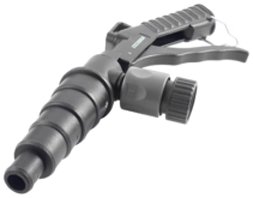
The flush gun I’m referring to contains a universal nozzle that fits various radiator or heater hoses and a lever-action air throttle with a lock-on latch for simple attachment of an air hose.
Directions: Leave the coolant hoses attached to the heater core and disconnect the inlet and outlet hoses. You will use the outlet to back-flush the core, and the inlet hose will allow you to control the excess to flow into a drain pan, jug, or bucket. Connect a water source and shop air to the gun and you’re ready to go. I like to flush heater cores in both directions – first, back-flush, then forward-flush.
If you want extra insurance, add a chemical coolant system cleaner simply by using a funnel and pouring it into one of the hoses, wait for the chemical to do its job (see the label with instructions for wait time), and then flush once more to thoroughly remove the chemical.
Precaution: When you recommend this procedure, warn your customer that it may reveal a leak in the core that was not leaking before because of the debris clog. In case of a leak, spread plastic to protect the carpet. Hopefully, these steps will help to remedy your customer vehicle’s low heat symptoms and get them back on the road in comfort.
Want to see how ALLDATA can improve shop efficiency? Check out our suite of products, each designed to contribute to both shop efficiency and productivity.
If you would like to read more articles like this one please subscribe to ALLDATA News.
