


How Artificial Intelligence (AI) Is Helping Technicians Diagnose Smarter
Experienced technicians rarely solve problems by guessing.
They follow a systematic process of gathering information, validating symptoms, performing tests, and eliminating possibilities until the root cause becomes clear. This methodical approach is what separates effective diagnosis from unnecessary parts replacement.
AI-assisted diagnostic tools can support that process by bringing likely causes, relevant tests, and repair information into view sooner. The technician still decides what to test and uses the results to confirm or rule out a fault.
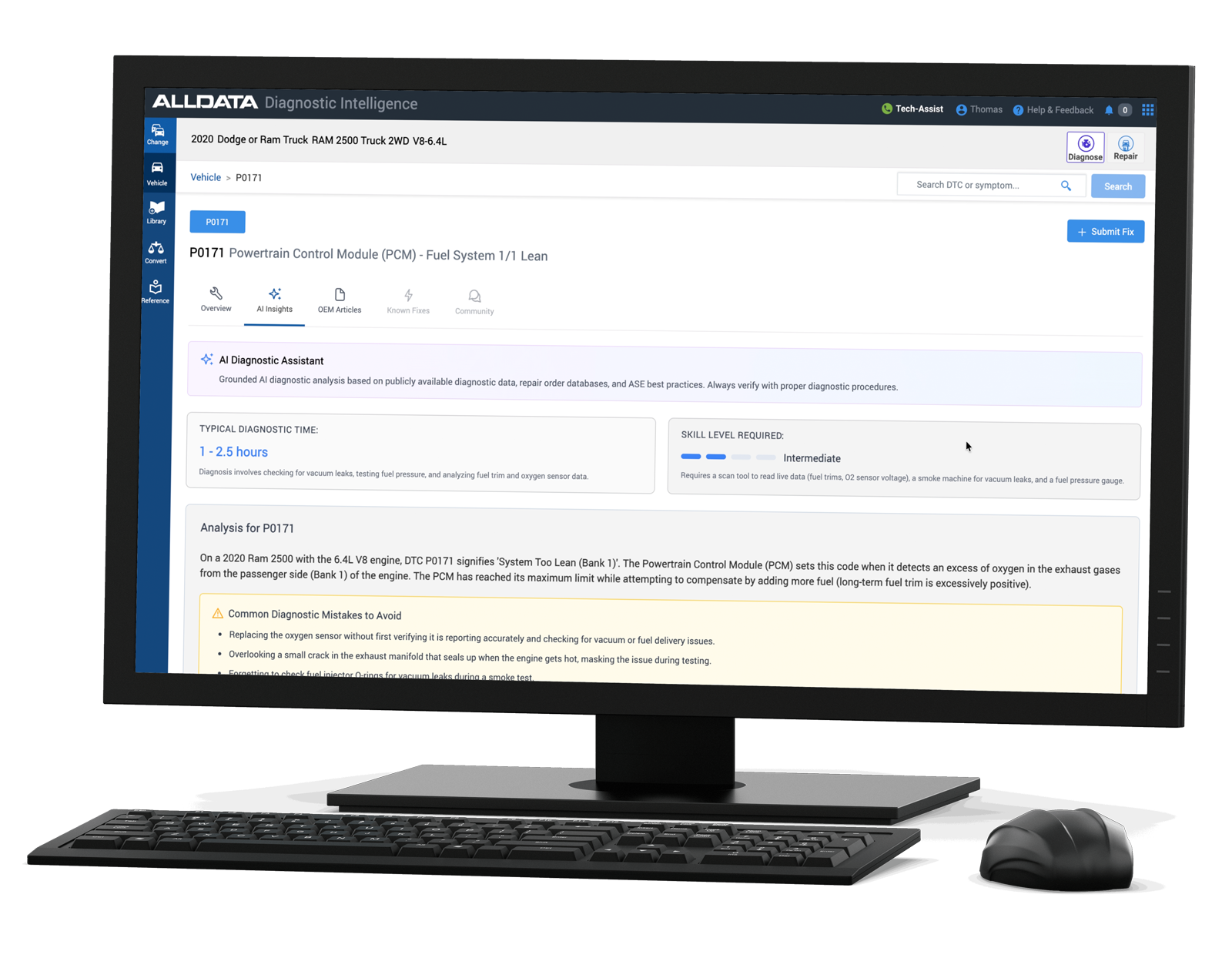
ALLDATA's new Diagnostic Intelligence™ helps technicians find a logical starting point. Once a technician searches by diagnostic trouble code (DTC) or symptom, Diagnostic Intelligence brings together probable causes, known fixes, shortcut tests, AI-assisted insights, and links to OEM service information. Rather than spending valuable time searching across multiple resources, the technician can focus sooner on testing and verification.
The benefits extend across every skill level.
For newer technicians, seeing probable causes alongside suggested tests and OEM procedures can help them understand why a particular check matters. That context gives them a place to begin while reinforcing the habit of verifying a cause before recommending a repair.
For experienced technicians, having relevant information in one place can mean less time spent searching and more time spent applying their judgment in the bay.
Closing the Experience Gap
The automotive industry continues to face a technician shortage, making training and development more important than ever.
One challenge facing many shops is that diagnostic expertise often resides with a relatively small group of highly experienced technicians. These professionals have spent years, or even decades, developing pattern recognition skills that allow them to quickly identify common failures and diagnostic paths.
However, transferring that experience to newer technicians can be difficult. AI-assisted diagnostics can help bridge that gap.
Technology will never replace the knowledge, judgment, and experience of professional technicians, but when designed correctly, technology can amplify those strengths.
While technology cannot replicate decades of hands-on experience, it can put relevant repair information and possible diagnostic paths within easier reach. That gives newer technicians more context for the questions they ask and the tests they choose.
Diagnostic Intelligence enhances this learning process by presenting likely causes, recommended diagnostic paths, and supporting repair information within a single workflow. This can help reduce dependence on a small number of senior technicians while providing less-experienced team members with a stronger foundation for diagnosing increasingly complex vehicle issues.
For shop owners and managers, that consistency can translate into improved efficiency, reduced comebacks, and more predictable repair outcomes.
The Future Is Technician-Driven
As vehicle technology continues to evolve, the diagnostic process will only become more complex. The shops that thrive will be those that successfully combine skilled technicians, trusted repair information, and intelligent technology. Artificial intelligence alone is not the future of diagnostics.
The future lies in the partnership between human expertise and purpose-built tools that make expertise more effective.
ALLDATA’s new Diagnostic Intelligence represents one way to put that combination to work. The diagnostic tool helps technicians move from a DTC or symptom to probable causes, relevant tests, and OEM procedures, while leaving the critical decisions in their hands.
Unlike general-purpose AI tools that depend heavily on prompts and user interpretation, Diagnostic Intelligence is purpose-built for automotive repair and designed to help technicians quickly identify relevant diagnostic information and connect directly to the OEM procedures needed to validate a repair strategy.
Technology will never replace the knowledge, judgment, and experience of professional technicians, but when designed correctly, technology can amplify those strengths. By helping technicians spend less time searching and more time solving problems, Diagnostic Intelligence supports faster, more confident decision-making while helping shops adapt to growing vehicle complexity.
For modern repair shops navigating increasingly complex vehicles, that combination of trusted information, guided workflows, and technician expertise may be one of the most valuable tools in the toolbox.
As diagnostics continue to evolve, tools like Diagnostic Intelligence can help shops improve productivity, support technician development, and deliver more efficient, accurate repairs for customers.
The best diagnostic process still depends on the person doing the work. AI simply helps that person find a better place to start.
Going to SEMA? Make sure to stop by the ALLDATA booths: North Hall, 11145 or Upper South Hall, 31061, for a demo.
Want to see how ALLDATA can improve shop efficiency? Check out our suite of products, each designed to contribute to both shop efficiency and productivity.
If you would like to read more articles like this one please subscribe to ALLDATA News.
