


Severed Ties: How a Battery Tray Cuts Off All Communication
If modern vehicle diagnostics have taught us anything, it’s that the problem isn’t always where the scan tool says it is. As you're well aware, today’s vehicles are smarter, faster, and more interconnected than ever, but they’re also less forgiving when something simply goes wrong. A rubbed wire, a bad ground, or a harness routed one inch too close to trouble can bring an entire network to its knees. That reality came into sharp focus during the diagnosis of a 2018 Chevrolet Malibu equipped with GM’s 1.5L turbocharged engine.
In this case, the Malibu rolled into the bay with a communication-related fault that refused to play nice. Initial testing didn’t raise any immediate red flags. CAN resistance measured roughly 62 ohms at DLC pins 6 and 14, right where it should be. From a textbook standpoint, the network looked intact. But when the signal was scoped, things started to unravel. The waveform was noisy, littered with static, and far from the clean signal you’d expect on a healthy CAN bus.
To make matters worse, a comparison scope capture from another vehicle didn’t look dramatically different. That opened the door to a whole new set of questions. Was this a wiring issue? A failing module? Or was the scope itself lying? At that point, it would’ve been easy to start throwing parts at the problem or blaming software gremlins. Instead, the technician did what seasoned techs learn to do sooner or later: Step away from the data and start looking at the car and any service bulletins that already exist.
In other words, the Malibu wasn’t suffering from a mysterious electronic failure; it was losing a fight with physics.
That’s when GM Bulletin 21-NA-186 entered the picture. The bulletin highlights a known issue involving engine control module harness chafing near the battery tray, a failure that won’t show up on a scan tool or announce itself with a flashing warning light. The fix requires something far less glamorous: a careful visual inspection of the harness for any potential points of failure.
Sure enough, once attention shifted to the engine compartment, the root cause didn’t take long to reveal itself. The ECM harness, routed near the battery tray, had been rubbing just enough over time to wear through the insulation on a blue-and-white communication wire. The result was an intermittent short to ground, exactly the kind of fault that can scramble network signals, trigger erratic behavior, and send diagnostics down the wrong path.
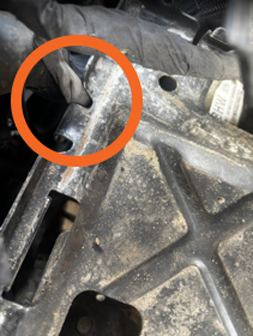
In other words, the Malibu wasn’t suffering from a mysterious electronic failure; it was losing a fight with physics. Once the insulation on the communication wire wore through, the CAN signal no longer had a clean path to travel. As the chafed wire intermittently contacted ground, voltage dropped, noise crept into the network, and data became corrupted. To the modules, that disruption looked like a complex electronic fault, even though the root cause was purely mechanical. No amount of software logic can overcome a wire that’s being rubbed raw against a battery tray.
The repair itself was refreshingly straightforward. The damaged wire was repaired, the harness was rerouted away from the battery tray, and extra abrasion protection was added before everything was secured back in place. After a reset and retest, the communication fault was gone. No comeback. Case closed.
The real takeaway isn’t the simplicity of the fix, but the reminder it delivers. In a world where diagnostics often begin and end on a screen, it’s easy to chase modules, corrupted data, or software gremlins when the problem is far more basic. A single chafed wire can mimic expensive failures if you’re not willing to get hands-on and actually put eyes on the vehicle.
This is also why OEM bulletins matter. These bulletins do not simply contain random information; they’re field scars turned into guidance, pointing techs toward problem areas that don’t show up in flowcharts or fault trees. Modern vehicles may be rolling networks of computers, but they’re still held together by wiring and routing decisions. And if an edge is sharp enough to cut you, it’s sharp enough to cut into a harness, too.
Want to see how ALLDATA can improve shop efficiency? Check out our suite of products, each designed to contribute to both shop efficiency and productivity.
If you would like to read more articles like this one please subscribe to ALLDATA News.
